Tanks
What's inside those mechanized fighting vehicles?
Firearms
See the insides of rifles, handguns, automatic weapons, etc.

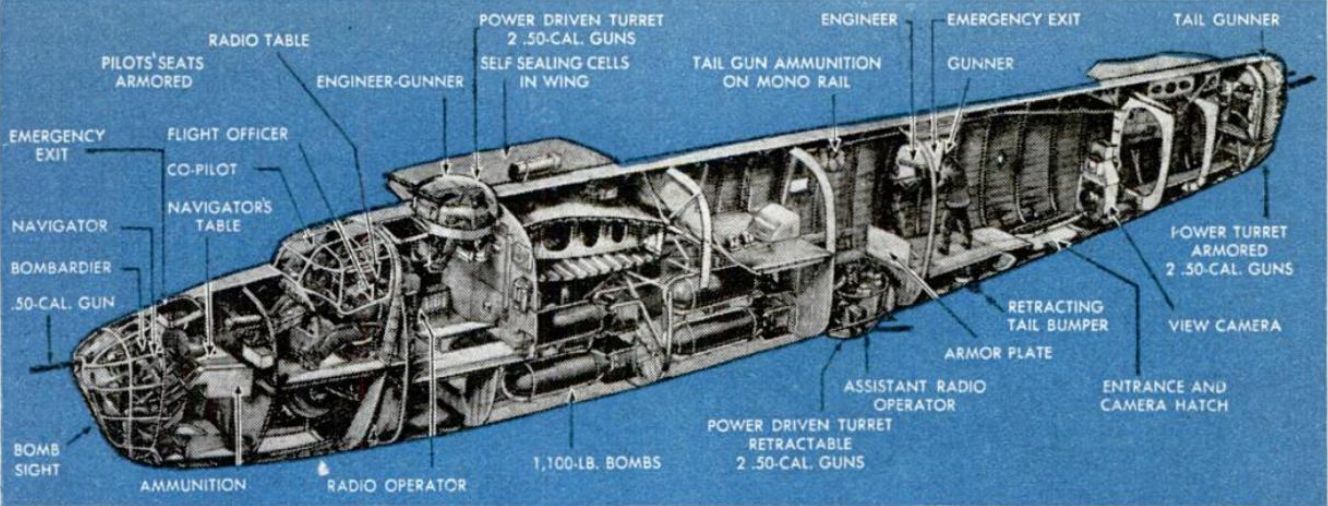
Naturally, in the popular press of the time, Consolidated Vultee’s B-24 Liberator bomber would be hailed as a magnificent fighting machine, capable of plowing down any obstacle like cutting through butter.

While the B-24 did have its strong points, crew members had a different angle on the craft. Lately, I have been reading Laura Hillenbrand’s book Unbroken: A World War II Story of Survival, Resilience and Redemption.  The person who is the centerpiece of the book, Louis Zamperini, who was a B-24 bombardier, says that the B-24 was called other names by crew members, such as “The Constipated Lumberer,” “The Flying Coffin,” and “The Flying Brick.”

Click to Enlarge to 1328 x 506 px:

B-24 Liberator Bomber Cutaway 1943

B-24 Liberator Bomber Cutaway 1943


Source:  Popular Mechanics November 1943

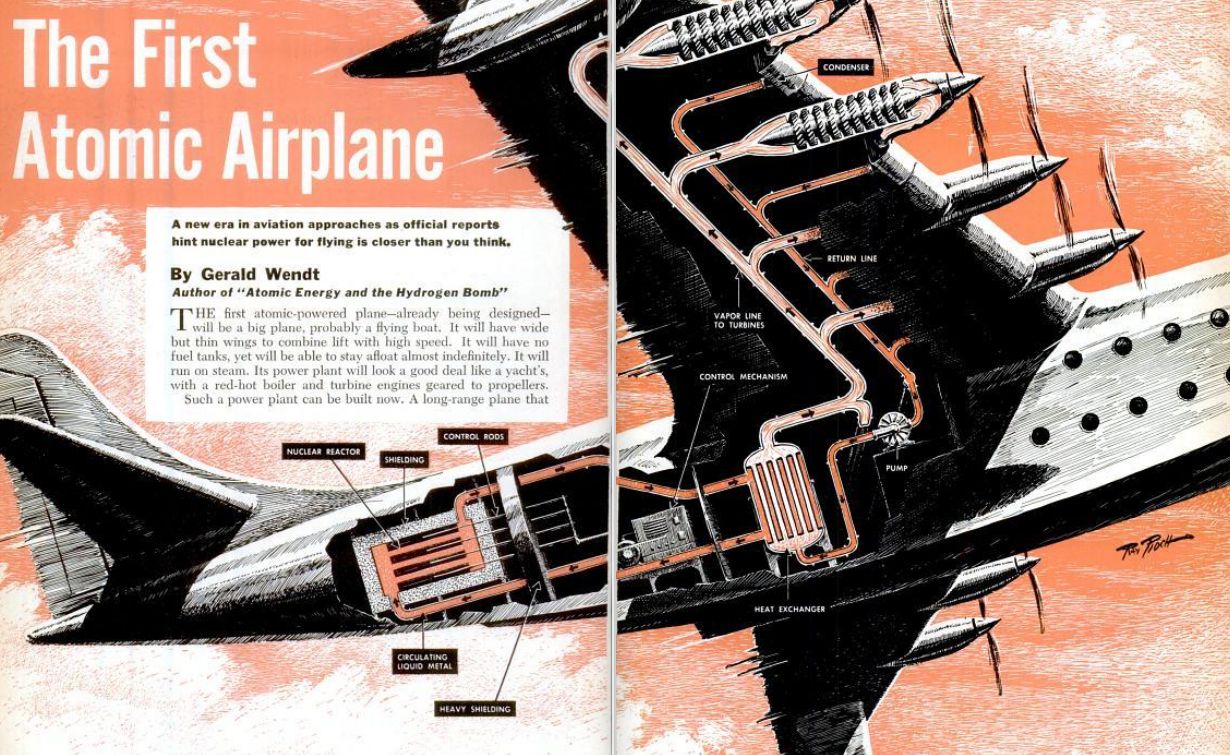
Even though I like Ray Pioch, his 1951 cutaway drawing of this fanciful atomic airplane really isn’t very good.  It’s got the typical middle-of-magazine two-color scheme, and the perspectives within this so-called atomic airplane are all wrong.

That said, it was predicted that, by 1980, atomic-powered jets would already be in use.  However, more realistically, it was said that the nuclear power plant would be so heavy (about 50 tons) that it would cost as much in terms of weight as a petroleum-fueled plane (power plant replacing fuel).

Another problem:  a radioactive engine being dangerous to the flight crew, extensive and heavy shielding would have to be added.

And another problem:  the nuclear reactor’s slow start-up time.

Click to Enlarge to 1230 x 755 px:

Atomic Airplane Cutaway 1951

Atomic Airplane Cutaway 1951

Source:  Popular Science October 1951

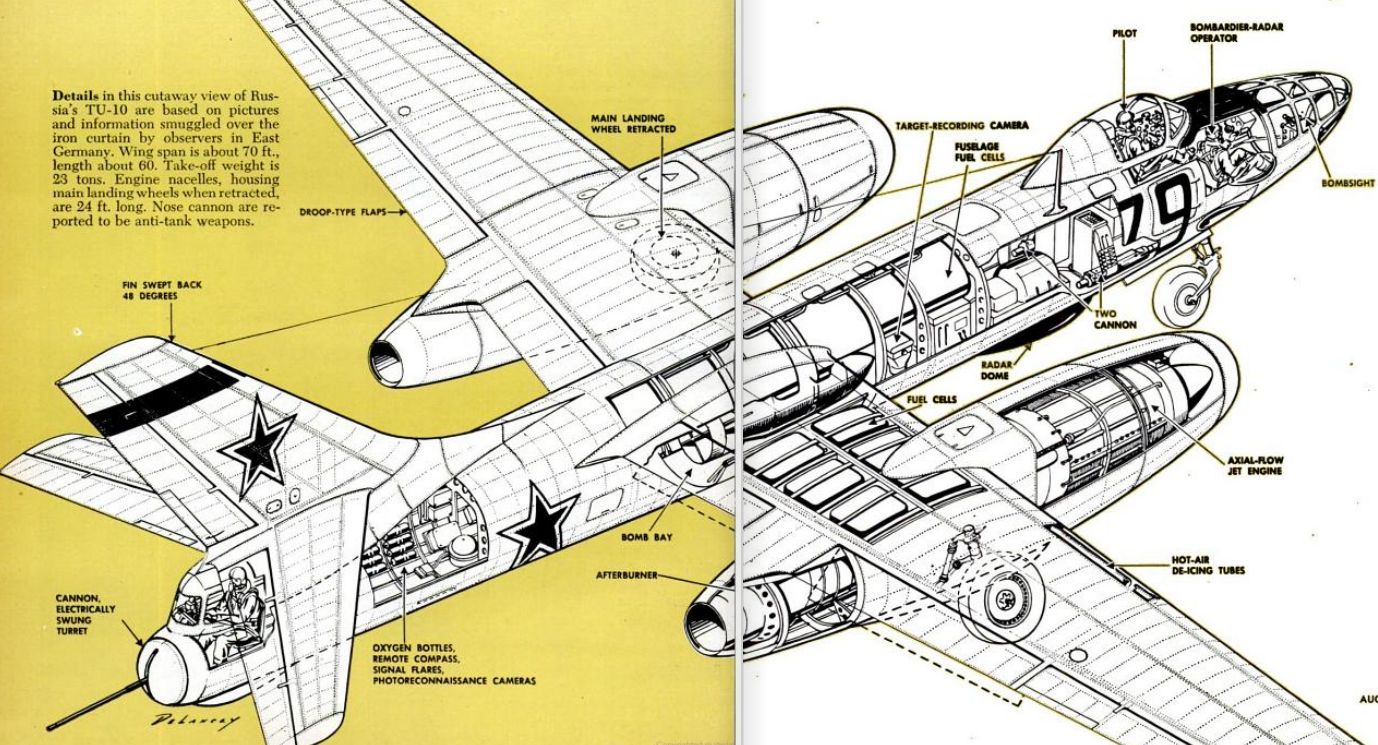
This is the Tupolev TU-10 bomber.  I have not been able to find information on this aircraft.  If anyone has leads, please leave information in the comment section.

Click to Enlarge Image to 1375 x 745 px:

Soviet TU 10 Two Jet Bomber 1951

Soviet TU 10 Two Jet Bomber 1951

Source:  Popular Science August 1951

You’re looking at a Douglas Skymaster C-54M that has been converted into a 32 litter (bed) “Flying Hospital.”

At the time this cutaway was drawn, the Korean War was in full force.  Rather than taking wounded soldiers home by ship or rail, Military Air Transport Service’s (MATS) C-54M took them home far faster and in better conditions.

Litters were a bit cramped (18.5 inches vertical clearance for each patient), but the “Flying Hospital” did have other superior accommodations, such as a full nurse’s station, air-conditioning, and galley for preparation of hot meals.

Click to Enlarge to 1607 x 735 px:

Douglas Skymaster C54M Flying Hospital Cutaway 1951

Douglas Skymaster C54M Flying Hospital Cutaway 1951

Source:  Popular Science April 1951

Only the cockpit of the XC-99?  Well, this plane was so freaking huge, we can barely show more than this.

Based on a B-36 bomber, the XC-99–built by Convair–flew 7,400 hours over the span of about 10 years.

Click to Enlarge to 786 x 742 px:

US Air Force XC-99 Cargo Plane Cockpit Cutaway 1951

US Air Force XC-99 Cargo Plane Cockpit Cutaway 1951

Source:  Popular Science March 1951

Where’s the pilot?  Well, maybe it’s not a plane.  Maybe it’s a missile of some sort.  But then, where’s the warhead?

You’re looking at a G.H. Davis cutaway drawing, 1956, of a Leduc 021 ramjet aircraft.  No pilot, no warhead.

The Leduc 021 was carried up by a Languedoc airliner, Space Shuttle-style, and then released.  The Leduc’s maximum ceiling was 65,000.

The reason for this unusual launch was because the Leduc used a ramjet instead of a rotary compresser (like you see on passenger jets) to force (i.e., ram) the much-needed air into the engine.  The jet had to build up a certain minimum airspeed in order for the jet to fire.

Click to Enlarge to 894 x 755 px:

French Leduc 021 Experimental Ramjet Cutaway, 1956

French Leduc 021 Experimental Ramjet Cutaway, 1956

A nice G.H. Davis cutaway (note “France” added just above his signature) of a French Baroudeur SE-5000.

See the landing gear on the Baroudeur?  No?  That’s because the Baroudeur (roughly translated to “adventurer”) is leaving its landing gear behind on the ground.  That’s right, the SE-5000 carried no gear, instead relying on a wheeled trolley to assist its takeoff.  It landed on grassy fields on skids.  This cutaway drawing shows the skids retracted.

Developed for NATO, this lightweight fighter, with a range of 1,500 miles, never entered production.

Enlarge to 1560 x 712 px:

French Baroudeur SE 5000 Fighter Jet 1956

French Baroudeur SE 5000 Fighter Jet 1956

Source:  Popular Mechanics May 1956

The Comet was quite a big deal when it was unveiled in 1950.  Both Popular Mechanics (Popular Mechanics’ deHavilland Comet Cutaway) and Popular Science pulled out all “cutaway stops” to feature this luxurious liner of the skies.

Here, illustrator Jo Kotula tips the Comet to an angle rarely seen in aircraft cutaways.

Click to Enlarge to 946 x 762 px:

Comet Airliner Cutaway 1950

Comet Airliner Cutaway 1950

Source:  Popular Science May 1950

Aircraft Carrier Steam Catapult, 1953

Aircraft Carrier Steam Catapult, 1953

Pictured is a 1953 cutaway of the planned HMS Perseus, showing the novel introduction of a steam catapult to replace the customary cylinder, ram, pulley, and wire catapults.

The plane is hooked to a long, slotted cylinder.  High pressure steam is released from the ship’s boilers into the cylinder.

As of the date of that article, only test planes and concrete weights had been launched.  But these test “flights” were highly successful.  One unpiloted test plane was flung to 1,500 feet and circled the ship for four minutes while everyone ran for cover.  Finally, its tanks ran dry and the plane fell into the sea.

Source: Popular Mechanics March 1953


In 1950, easy passenger jet travel was still a dream that could excite the public.  The deHavilland Comet was still in its infancy when, for a test flight, it flew from London to North Africa, a distance of 3,000 miles, at a top speed of 450 miles per hour.

See Another Cutaway View of a Comet, 1950

The Comet was designed for maximum passenger (and crew) comfort and safety, with feature unheard of in today’s jets:  separate room for hats and coats, gender-segregated washrooms, a dinghy stored in the wing, a First Class front cabin, large galley, and a room for stewardesses.

The Comet officially took off for regular passenger service on May 2, 1952.  But the Comet was not destined for great things.  Within only a year, the deHavilland Comet first crashed, a victim of metal fatigue.  The accident in Karachi, Pakistan, which killed 11 people, bestowed a new distinction on the Comet:  the first passenger jetliner crash resulting in fatalities.

Click to Enlarge to 1526 x 700 px:

British DeHavilland Comet Passenger Jet, 1950

British DeHavilland Comet Passenger Jet, 1950

Popular Mechanics:  April 1950