Tanks
What's inside those mechanized fighting vehicles?
Firearms
See the insides of rifles, handguns, automatic weapons, etc.

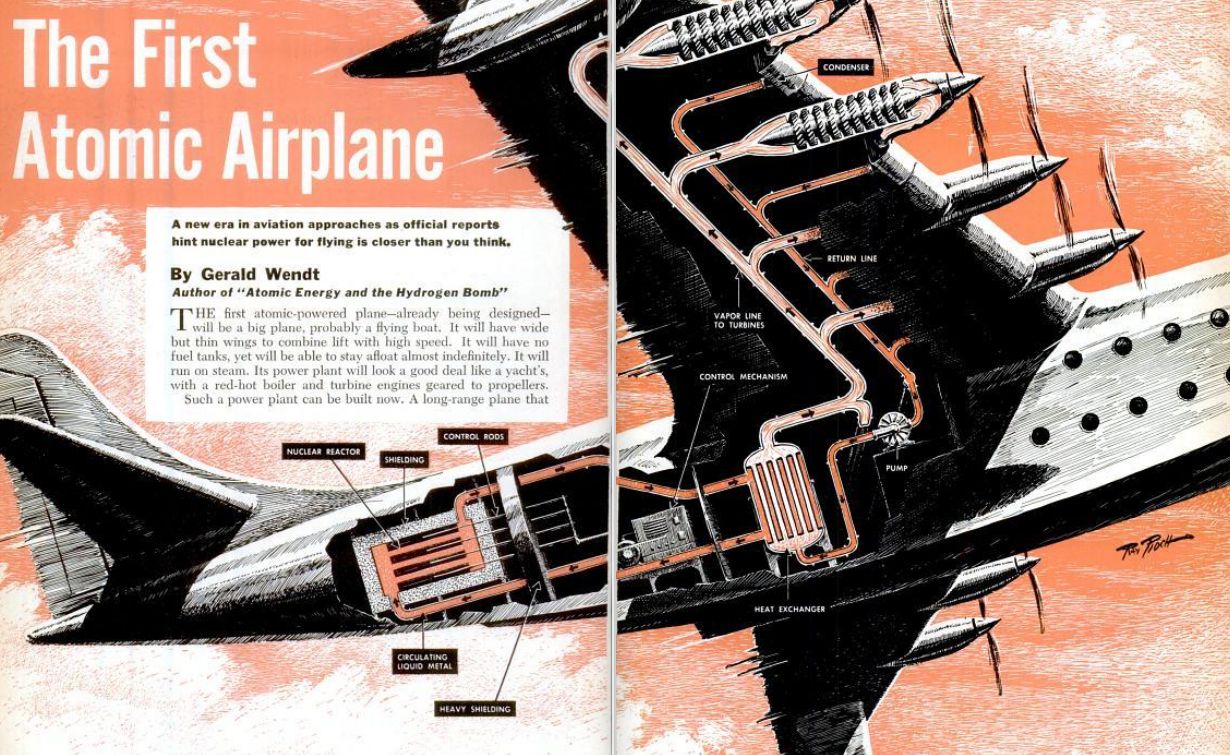
Even though I like Ray Pioch, his 1951 cutaway drawing of this fanciful atomic airplane really isn’t very good.  It’s got the typical middle-of-magazine two-color scheme, and the perspectives within this so-called atomic airplane are all wrong.

That said, it was predicted that, by 1980, atomic-powered jets would already be in use.  However, more realistically, it was said that the nuclear power plant would be so heavy (about 50 tons) that it would cost as much in terms of weight as a petroleum-fueled plane (power plant replacing fuel).

Another problem:  a radioactive engine being dangerous to the flight crew, extensive and heavy shielding would have to be added.

And another problem:  the nuclear reactor’s slow start-up time.

Click to Enlarge to 1230 x 755 px:

Atomic Airplane Cutaway 1951

Atomic Airplane Cutaway 1951

Source:  Popular Science October 1951

Where’s the pilot?  Well, maybe it’s not a plane.  Maybe it’s a missile of some sort.  But then, where’s the warhead?

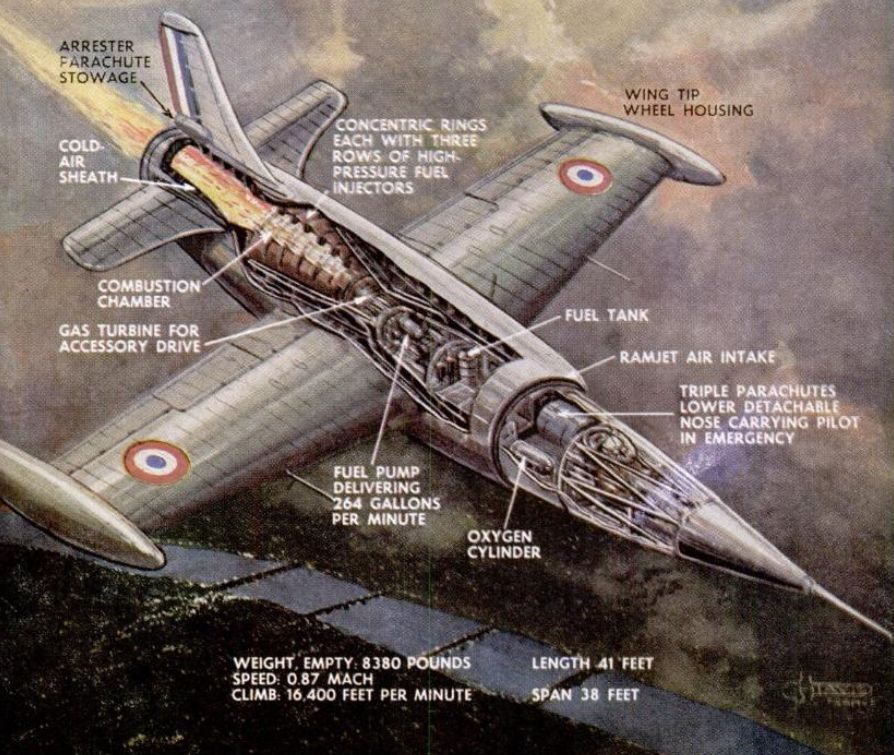
You’re looking at a G.H. Davis cutaway drawing, 1956, of a Leduc 021 ramjet aircraft.  No pilot, no warhead.

The Leduc 021 was carried up by a Languedoc airliner, Space Shuttle-style, and then released.  The Leduc’s maximum ceiling was 65,000.

The reason for this unusual launch was because the Leduc used a ramjet instead of a rotary compresser (like you see on passenger jets) to force (i.e., ram) the much-needed air into the engine.  The jet had to build up a certain minimum airspeed in order for the jet to fire.

Click to Enlarge to 894 x 755 px:

French Leduc 021 Experimental Ramjet Cutaway, 1956
French Leduc 021 Experimental Ramjet Cutaway, 1956

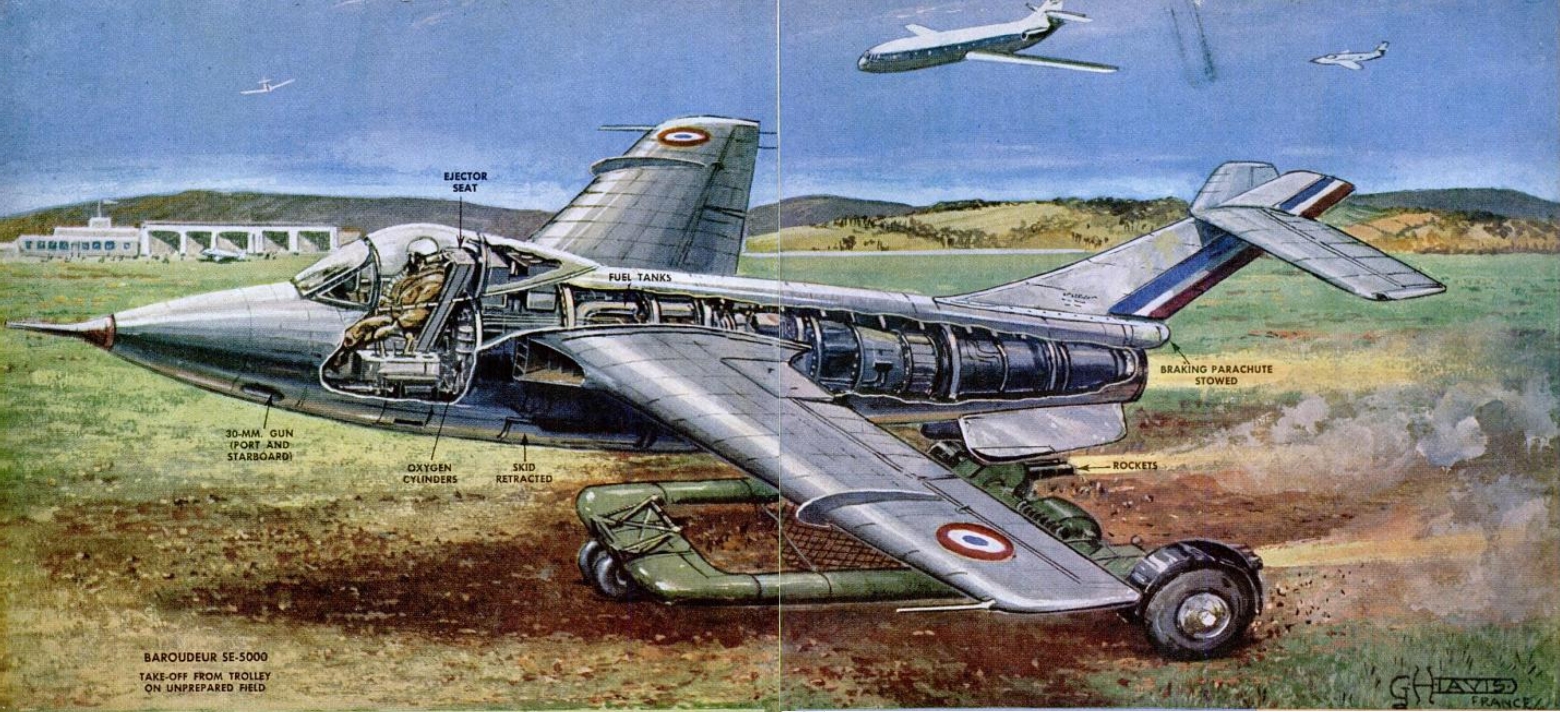
A nice G.H. Davis cutaway (note “France” added just above his signature) of a French Baroudeur SE-5000.

See the landing gear on the Baroudeur?  No?  That’s because the Baroudeur (roughly translated to “adventurer”) is leaving its landing gear behind on the ground.  That’s right, the SE-5000 carried no gear, instead relying on a wheeled trolley to assist its takeoff.  It landed on grassy fields on skids.  This cutaway drawing shows the skids retracted.

Developed for NATO, this lightweight fighter, with a range of 1,500 miles, never entered production.

Enlarge to 1560 x 712 px:

French Baroudeur SE 5000 Fighter Jet 1956

French Baroudeur SE 5000 Fighter Jet 1956

Source:  Popular Mechanics May 1956

A gorgeous noir-like cutaway of an atomic pile by Alexander Leydenfrost.  But why does the drawing look so vague and devoid of details?

Partially, that was the Leydenfrost style.  His Brooklyn-Battery Tunnel cutaway drawing shows that he emphasized moody shadows and light over the cool and the technical.

But mainly, at the time of this illustration, atomic production was still a closely guarded secret.  So Leydenfront had to imagine what a pile must look like based on scant information from The Smyth Report.

Published in July 1945, the Smyth Report, officially known as The Official Report on the Development of the Atomic Bomb Under the Auspices of the United States Government, provided a technical, though generalized, overview of the production of nuclear weapons.

Click to Enlarge to 1609 x 766 px:

Atomic Pile Cutaway 1950

Atomic Pile Cutaway 1950

Source:  LIFE February 27, 1950

Illustration by Ray Quigley shows an anti-sub device from 1950 termed “the hedgehog.”

It lobbed multiple depth charges all at once at the presumed submarine location.  Charges were slightly angled so that they would land in a spreadout, scattershot pattern, covering a wider range.

 Click to Enlarge to 695 x 768 px:

Ship-Based Anti Submarine Defense Cutaway, 1950

Ship-Based Anti Submarine Defense Cutaway, 1950

Source:  Popular Science March 1950

A gorgeous late 1960s cutaway from Pierre Mion for the “Deep Diver,” a ferry submarine designed by Edwin A. Link and built by Perry Submarine Builders, Riviera Beach, FL.

This 22-foot, 4-man craft was meant for work, not play–underwater construction or research.

Interestingly, Perry Submarines is still around and making submersibles, one of which is going for $695,000!

Click to Enlarge to 1108 x 761 px:

Deep Diver Ferry Submarine Cutaway 1967

Deep Diver Ferry Submarine Cutaway 1967

Source:  Popular Mechanics July 1967

The Brooklyn-Battery Tunnel was new in 1950, when Alexander Leydenfrost drew this cutaway.  At 9,117 feet, it is the longest continuous underwater tunnel in North America, according to Wikipedia.

Click to Enlarge to 818 x 771 px:

Brooklyn Battery Tunnel 1950

Brooklyn Battery Tunnel 1950

Source:  Popular Mechanics May 1950

In writing about the technical/cutaway illustrators of the 20th century, I am accustomed to seeing dates of death in the 1950s and 1960s.

Some, like the great Rolf Kelp, managed to live into the 1980s.

Imagine my delight at seeing that Pierre Mion is still alive and quite kicking.

Mion’s biography indicates that his magazine work was related to the topics of “historical, oceanographic, architectural, geological, mining, forestry, environmental and transportation.”

Mion is a hands-on illustrator.  For our featured Deep Diver (1967), Mion’s bio states that he took test dives in the Bahamas to get a feel for the craft.

A graduate of Montgomery College, Rockville, MD and George Washington University, Washington, DC, Mion also produces western landscapes, waterscapes, pictures of people and animals, and a myriad of other fine artworks.

Mion now lives in Cornville, AZ.

Pierre Mion


G.H. Davis

G.H. Davis

Like most magazine illustrators of the early to mid 20th century, little is known about George Horace Davis.

From a site dedicated to The Illustrated London News (ILN), we learn that he spent 40 years contributing to that publication, producing up to 2,500 pages of illustrations.

Born in Kensington in 1881, Davis was first published in ILN on July 29, 1923.  He learned art at Ealing School of Art and served with the RFC during WWI.

Davis died December 7, 1963