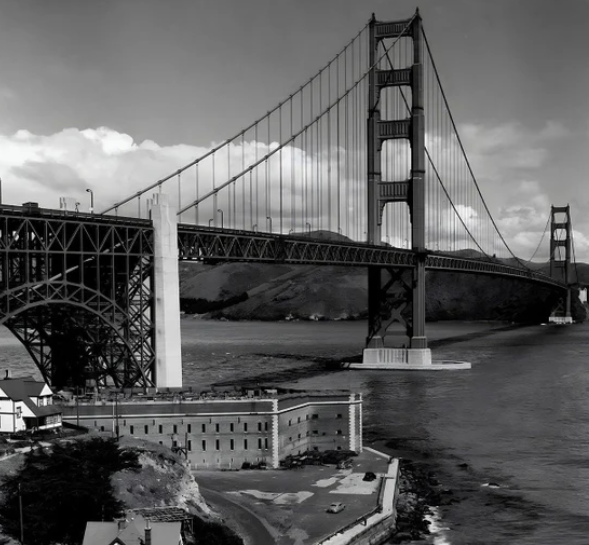
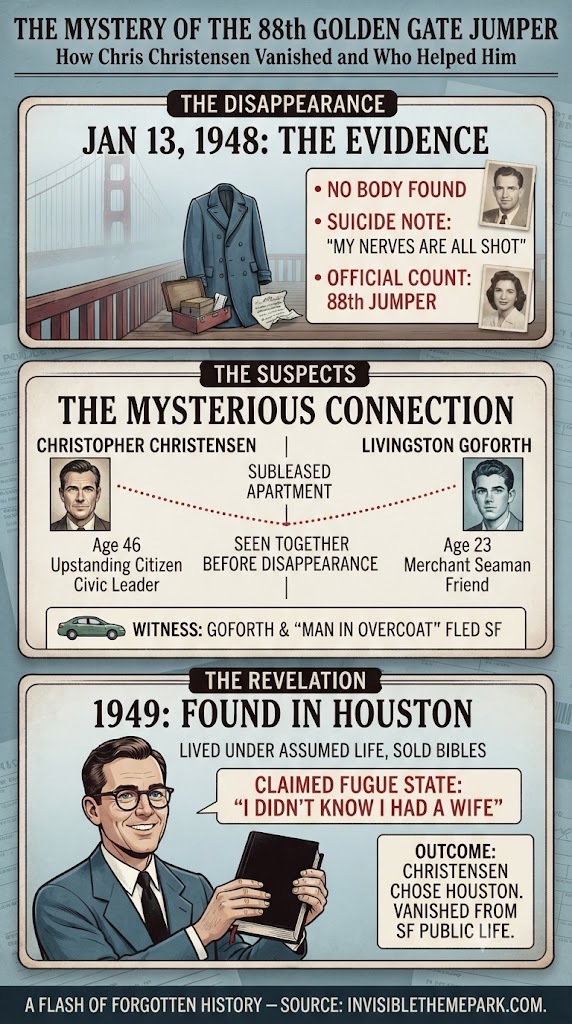
On January 13, 1948, above the chilly waters of the Golden Gate Bay, a double-breasted blue serge coat was found next to the railing of the Golden Gate Bridge.
It was tied to a painter’s box, along with a note:
Loved ones: my nerves are all shot. Please forgive me. Chris.
“Chris” was Chris Christensen, the 88th person to jump off of the Golden Gate Bridge. At least, that was the official version.

Upstanding Citizen
At 46 years old, Chris Christensen was a pillar of San Francisco life.
Married to Juanita Christensen, he had a married daughter, a son Chris, who was a student at University of California, Berkeley, and a second son, Brent.
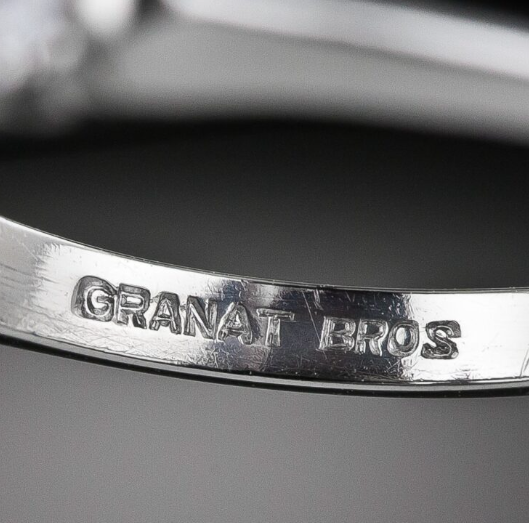
He was a manager at Granat Brothers, a high-end jewelry retailer and fabricator in the Mission District. He was also an official at the California Retailer Jeweler’s Association.
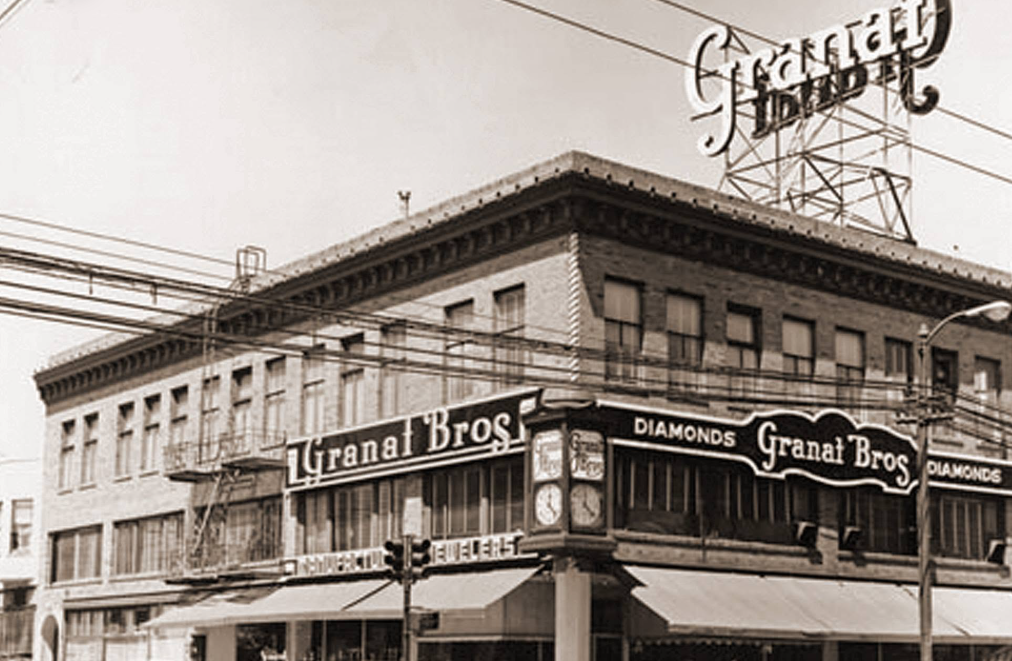
Christensen served the public as a member of the San Francisco Board of Supervisors, a Director of the San Francisco Chamber of Commerce, and Executive Director of the Mission YMCA.
The San Francisco Chronicle called Christensen “a solid businessman who had built a place for himself is a solid community.”
Clearly, this balding, bespectacled Mason was the last person who would do anything out of the ordinary.

Cracks in the Story
Many doubted that Christensen had committed suicide.
The Coast Guard was unable to locate a body. No one saw him jump. He appeared to have jumped with his hat and overcoat, though he left other items—his suit jacket and some money—on the bridge.
Friends, including his doctor, asserted that he was “not the type of man who commits suicide.”
Then, a mysterious lead emerged. William Herrmann, a fellow employee at Granat Brothers, said, “Find Livingston Goforth and you’ll find Chris.”
A Sailor Surfaces
Born in Washington, DC, Livingston Goforth was a merchant seaman. The 23 year-old Goforth was characterized as “willowy…almost too good-looking to be considered handsome.”
Goforth occupied an apartment at 460 Ellis Street. The apartment was rented by Pat Kelly—an employee at Granat Brothers.
What raised eyebrows was that none other than Chris Christensen had subleased the apartment from Kelly. Christensen received all of Goforth’s forwarded mail when he was on the high seas.

Mysterious Friendship
Christensen was described as “taking a fatherly interest in the former U.S. Navy sailor,” who was half his age.
The friendship wasn’t secret. Goforth told his mother, Mrs. Anna Goforth of Little Rock, Arkansas: “Chris is the best friend I’ve got.” In 1947, Juanita Christensen even took Goforth alone on a trip to Lake Tahoe.
Goforth seemed to have a connection with Christensen’s disappearance. Goforth had been spotted in San Francisco on the day before Christensen jumped off the bridge. That day, Goforth had also telephoned his mother in Arkansas, asking for money.
Christensen Is Found
In 1949, Christensen was found in Houston, Texas, traced by a San Francisco reference he had left at a Houston employment agency.
Christensen was selling Bibles and doing well. On his first day, he sold $13.50 worth of Bibles.
When confronted by reporters, he said, “I’ve been doing what I want to do all day. I’ve been selling Bibles. Why don’t people leave me alone? Just because I was somebody once—why bother me?”
He said a fugue-like state was behind his disappearance, claiming that he didn’t know who he was for months.
“I didn’t know I had a wife anymore,” he said. “I thought she was dead.” After three or four months, he “began to get a straight picture” of who he was.
To explain how his disappearance happened, Christensen said:
I remember walking out on the Golden Gate Bridge. Then something happened. I don’t know what. The next thing I knew is I was sitting in the depot. I went through my pockets to see who I was and found a ticket to Los Angeles. I thought I was supposed to go to Los Angeles.
Houston or San Francisco?
Juanita Christensen flew to Houston and “fell into his arms.”
When asked whether her husband would return to San Francisco, her response was measured: “Maybe it’s best if he wants to stay. If he ever wants to come home, there is a place for him.”
In the end, Christensen chose to remain in Houston.
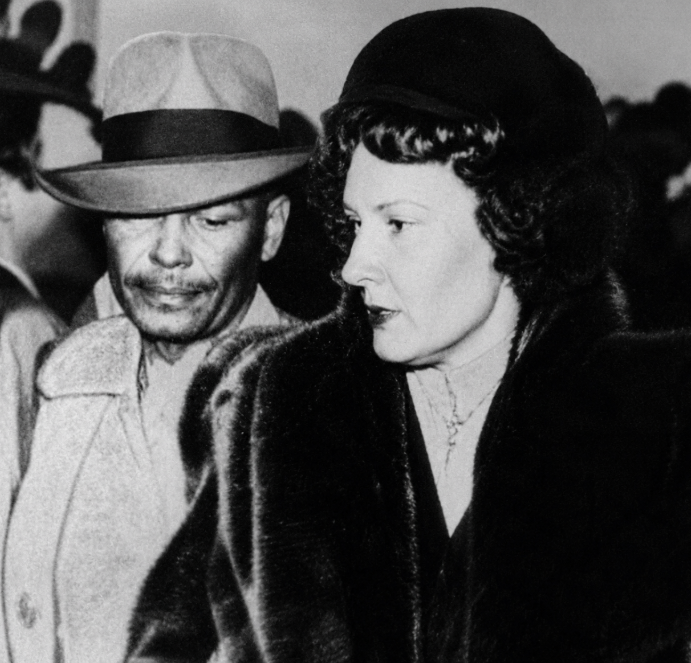
A Special Kind of Friend?
Did Christensen run away with Goforth? It’s not conclusive, but clues point in that direction.
Christensen and Goforth were described as “friends,” with Goforth occupying Christensen’s apartment. Both were in Los Angeles around the same time. Both ended up in Houston. And then, the pair was seen shortly before Christensen disappeared.
Don DeMoss, a friend of Goforth, told police that he had met Goforth on Tuesday, two days before the disappearance. Goforth was agitated and he asked his friend for help.
Along with Goforth, DeMoss got into a 1947 green sedan parked outside the coffee shop. In back: a man wearing an overcoat who he swore was Christensen.
DeMoss drove the pair to the Golden Gate Avenue YMCA—the same YMCA where Christensen was an Executive Director. The man in back remained in the car while Goforth signed for the room.
DeMoss stayed in adjoining room that night. He thought he heard a voice in the Goforth room say: “We’ve got to get out of here. They’ll be looking for us.”

Epilogue
Goforth later became active in Houston social life. He was involved with a Galveston yacht club and crewed a winning sloop in a race sponsored by the Houston Yacht Club.
Livingston Goforth died in 1981 at the age of 58 in McAllen, Texas. He was survived by his mother, father, three sisters, and one brother. No wife survived him, and no wife preceded him in death.
Granat Brothers was sold to mega-jeweler Zales in 1961. Granat jewelry is highly valued and can be found in antique stores to this day.
Chris Christensen was never heard from again—his disappearance now complete.