


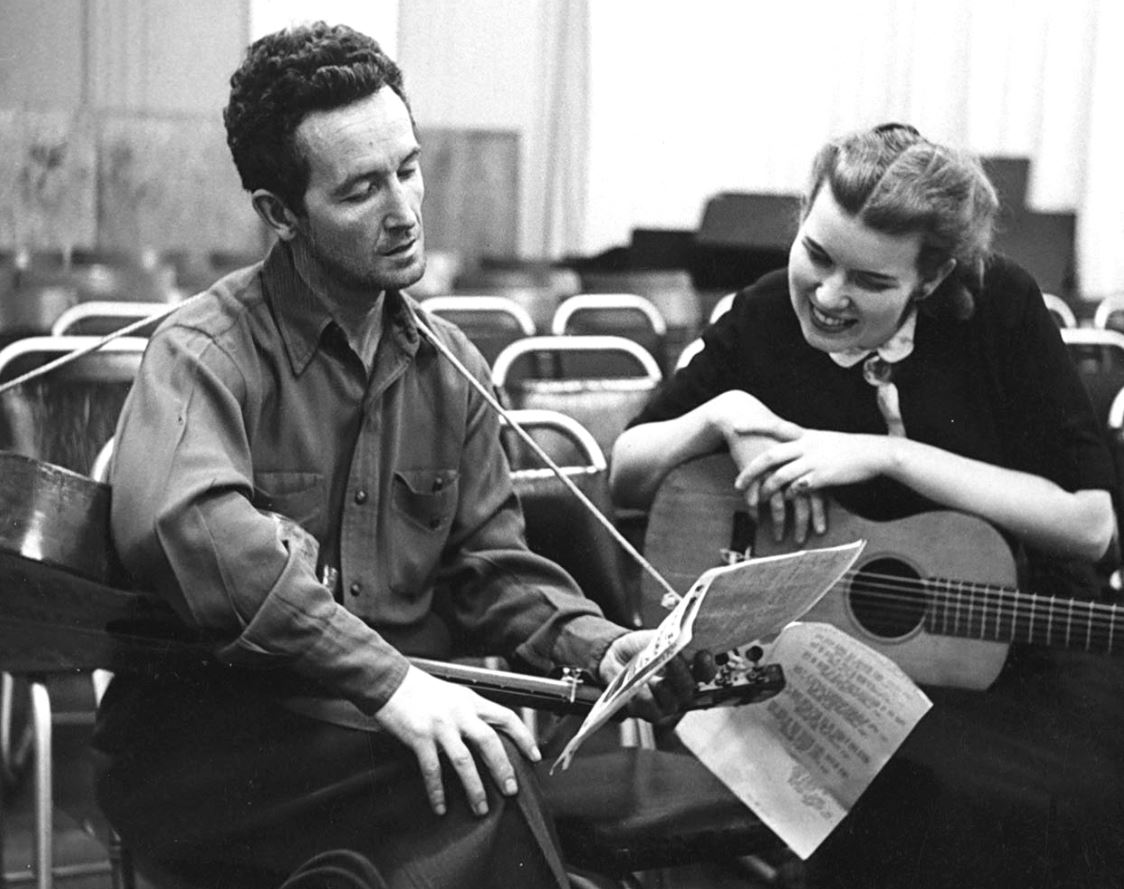
It was a plane crash that killed 32 people, largely Mexican nationals, and spawned Woody Guthrie’s poem that later became the song “Deportee (Plane Wreck at Los Gatos).”
Recorded by Joan Baez, Kingston Trio, Hoyt Axton, Nanci Griffith, Concrete Blonde, Billy Bragg, Bruce Springsteen, and countless others, “Deportee” is a tight little package that protests what Guthrie considered to be the mistreatment of the passengers before and after the accident.
One contemporary mainstream media view of the song comes from NPR, highlighting the 1948 deportation of 32 Mexican nationals and stating that their “death [was] marked by anonymity when their names were lost in the accident.”
While some bodies were able to be identified, local officials made a concerted effort to try to connect the rest of the bodies with names.

The Crash in Los Gatos
On January 28, 1948, a DC-3 plane carrying 32 people went down in rugged Los Gatos Canyon, near Coalinga, California, about 200 miles south of the San Francisco Bay Area.
The crash killed the 32 people on board: 28 Mexican nationals, all men except for one woman, and four Americans. The Americans were a husband-and-wife pilot/stewardess team, Frank and Billie Atkinson; co-pilot Marion Ewing; and Immigration Inspector Frank Chaffin.
A road crew working in the area saw the plane go down, and they were the first responders. Some bodies were strewn so far away from the plane that newspaper accounts at the time speculated that some of the men had tried to jump before the plane crashed. No solid explanation for the crash was ever produced.
Living in New York at the time, Woody Guthrie read about the plane crash in a January 29, 1948 article in the New York Times. Seeing only the names of the four Americans listed and none of the Mexican nationals’ names, Guthrie wrote a poem about how the as-yet-unnamed Mexicans were left “To fall like dry leaves to rot on my topsoil / And be called by no name except deportees.”
The article was published just one day after the crash, and no names were supplied in that newspaper account. Guthrie imagines a few of his own names:
Goodbye to my Juan, goodbye, Rosalita,
Adios mis amigos, Jesus y Maria;
You won’t have your names when you ride the big airplane,
All they will call you will be “deportees”
Attempts Made to Identify Bodies
Guthrie was likely unable to read past that first initial account because there were none. The crash was not a local story; the New York Times only reported the crash on January 29, with no pieces published in the Times beyond that second day.
Yet local officials in California “eagerly sought” the names of the Mexican nationals starting on the day after the crash.
On January 28, the day of the crash, even the local Fresno and Bakersfield, California newspapers reported knowing only the names of the four Americans and none of the Mexican nationals.
But already by the second day, as reported by the Bakersfield Californian, both American and Mexican officials were working to identify the names of the Mexicans.
Another local newspaper, the Fresno Bee, was eventually able to list the names of every Mexican national that officials could confirm to be on that doomed flight.
After sifting through the burning debris and mangled bodies, officials were able to identify 11 of the Mexicans positively; that is, in 11 cases, they matched a body to an identity.
The remaining names listed on the transport list could not be matched to bodies. These names were publicly listed by immigration officials and published in local newspapers:
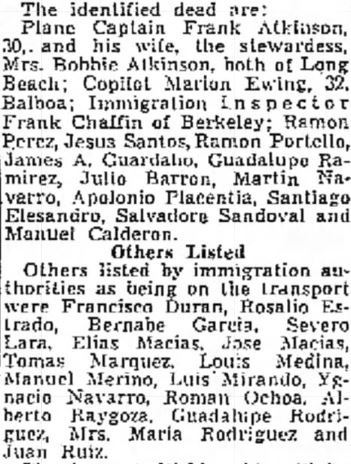
One aspect that complicated matters, according to I.F. Nixon, regional immigration director in San Francisco, was that all were “agricultural workers who had slipped across the border without a passport or had overstayed their work permits.”
With any fiery plane crash, identification is difficult. Identifying the Mexicans in the Los Gatos crash was even more complicated due to the lack of identification.
Some were workers who stayed in the U.S. beyond the work permits provided as part of the Bracero Program. In the 1940s, the Bracero Program was intended to standardize living conditions and provide fair wages for migratory workers.
In the end, positive identification of the remaining bodies was deemed impossible due to the incredible impact of the plane crash and subsequent fire. Fresno County Deputy Coroner L.R. Webb said, “The rest may never be identified, so badly were the bodies broken and burned.”
The Aftermath
- All 28 Mexican nationals were buried in a mass grave at Holy Cross Cemetery, Fresno, California.
- The location of immigration guard Frank Chaffin’s remains are unknown, but he is marked on the mass grave memorial with the Mexican nationals.
- Marion Harlow Ewing (b. 1915), the co-pilot, was buried at Ivy Lawn Memorial Park, Ventura, California.
- Both Francis Atkinson and Lillian (Billie) Atkinson are buried at Holy Sepulchre Cemetery, Rochester, New York.
- Subsequent writers, such as Tim Z. Hernandez in his book All They Will Call You, give a more complete version of the story. Hernandez spent six years searching for families of the dead, and he was instrumental in obtaining funding for a new memorial that lists the names of all of the dead.
By the third day, media reports of the Los Gatos crash and practically all other news items were buried by a stunning event of international importance: Mahatma Gandhi’s assassination.


